Background
Cameron leads the vendor risk management program at a global financial services firm, operating at the intersection of procurement, security, compliance, legal, and regulatory oversight. The role encompasses:
- All third-party relationship assessments and classifications
- Vendor performance monitoring and SLA tracking
- DORA, EBA, MICA, ROPA, and joint state regulatory compliance
- Working with security, legal, finance, compliance, engineering, and business owners
The Challenge: Fragmented Systems and Manual Compliance Work
"Before we met you guys, all of this work was done manually," Cameron explains. "It took us months to do some of the things that Clarative is doing instantly."
The organization faced three critical challenges that existing procurement and GRC tools couldn't solve:
Fragmented Oversight Across Multiple Systems
Vendor data and oversight activities were scattered across a procure-to-pay tool, contract repository, incident management platform, and countless spreadsheets.
"This made it difficult to see vendor performance holistically, correlate incidents to contractual obligations, and quickly identify which vendors supported critical important functions," Cameron notes.
There was no single source of truth. Manual data pulls were required to understand criticality, regulatory exposure, and vendor performance.
DORA, EBA, MICA, & ROPA Compliance
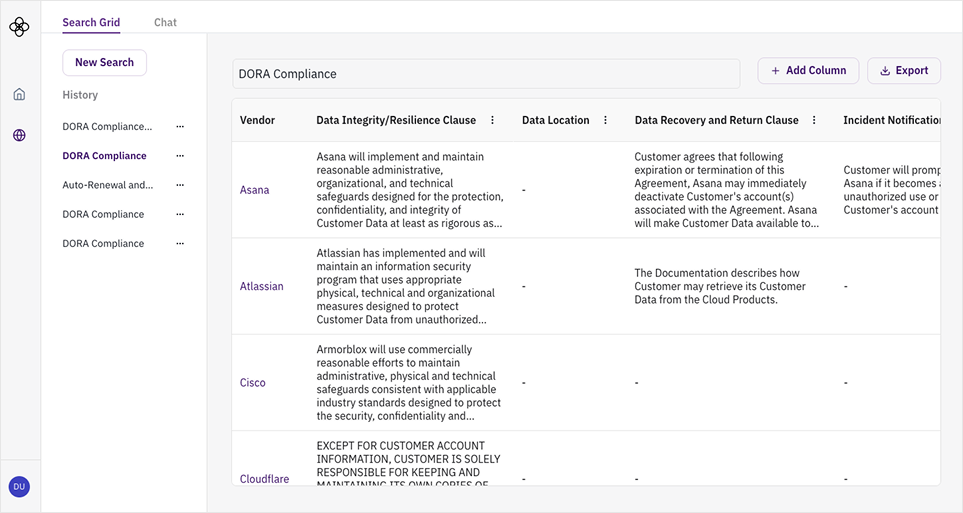
Meeting DORA, EBA, MICA, and ROPA requirements for identifying and classifying critical ICT providers required capabilities that simply didn't exist in their current tools.
"There was a gap within our framework and with our governance that we needed to remediate that we couldn't do in any Procure-to-Pay or a GRC tool that currently exists in the market."
The organization needed to classify ICT vendors, identify contractual gaps for remediation, and provide ongoing monitoring, but had no automated way to track uptime, risk events, or performance.
"We had to manually track SLAs, monitor outages, and report on those," Cameron explains. "it took us was probably at least 16 hours out of a month, which is really a lot."
They were expected to report these metrics to boards, GRC teams, and business units for risk appetite assessment and quarterly business reviews. Without a systematic approach to vendor classification, contract remediation, and ongoing monitoring, compliance was nearly impossible.